HELGEWIRTH.COM
New Analytical Methods for Graphical Knowledge Extraction
Iconocartographic Virtual Museums
Cartography originates in the intention to
communicate aspects of an environment
to an intended recipient.

Several projects within our scientific initiative have brought to light insights into well-known species and artefacts that could not be revealed even by earlier research conducted with the greatest methodological rigour. The following projects are particularly noteworthy:
Analysis of archaeological (c-)artefacts
1. The Tal-Qadi Stone
According to our analyses, the Tal-Qadi Stone represents the earliest verifiable physical long-range maritime map in human history. The engravings indicate a systematic understanding of large-scale sea routes that clearly exceeds the scope of purely local navigational representations.
2. Sumerian Pathways of Water and Sky
This project focuses on the reconstruction of the earliest known world map of the heavens. Sumerian cuneiform sources and symbolic representations reveal a coherent model of cosmic order in which river systems, stellar paths, and divine spheres were conceived as an integrated system of navigation and orientation.
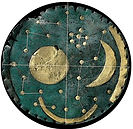
3. Iconocartography of the Nebra Sky Disc
A logical map of a Bronze Age worldview?
This project interprets the Nebra Sky Disc not primarily as an isolated astronomical object, but as a logically structured map of a Bronze Age conception of the world and the heavens. The combination of celestial bodies, horizon arcs, and cyclical markers is understood as a deliberately coded medium of communication, organising cosmological knowledge in a cartographic manner.
Cartogrammatic
4. Reading and creating of maps
Map awareness as a key to cartographic communication
This foundational project investigates map awareness as a cultural competence: the ability not merely to view maps, but to read, describe, and interpret them as symbolic, logical, and communicative systems. The study demonstrates that cartographic communication constitutes a universal human practice that long predates modern cartography.